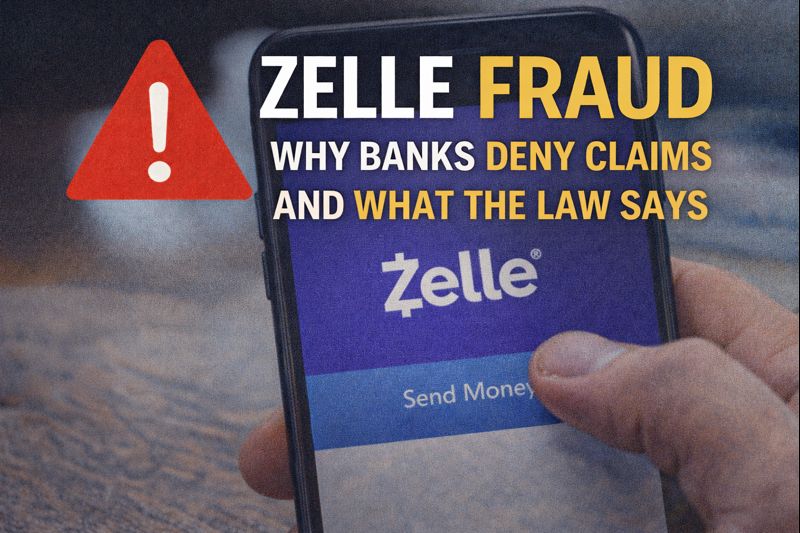
Zelle fraud has become one of the fastest-growing forms of bank fraud in the United States. Consumers across the country are reporting unauthorized Zelle transfers, drained bank accounts, and denied fraud claims—often within minutes of discovering the theft. Even worse, many banks tell victims the same thing:
“Zelle payments are final.”
That statement is misleading, and in many cases, legally incorrect.
If your bank denied your Zelle fraud claim or blamed you for an unauthorized transfer, you may still have strong legal rights.
What Is Zelle Fraud?
Zelle fraud occurs when money is sent from your bank account through Zelle without your authorization. This often happens when scammers gain access to your account credentials or trick you into revealing security codes.
Common Zelle fraud scenarios include:
Unauthorized Zelle transfers you never approved
Scammers posing as your bank’s fraud department
Phishing texts claiming suspicious activity on your account
Calls asking you to “reverse” or “secure” a transaction
Account takeovers after data breaches or stolen passwords
Once the transfer is sent, the money often disappears immediately—leaving victims panicked and banks reluctant to help.
Why Banks Commonly Deny Zelle Fraud Claims
Banks frequently deny Zelle fraud claims by saying:
“You authorized the transaction.”
“You shared your credentials.”
“Zelle payments are instant and irreversible.”
“Our investigation verified the transfer.”
“This does not qualify as fraud.”
These denials are extremely common—even when the consumer never intended to send money.
Banks rely on the idea that Zelle is a peer-to-peer payment service, shifting responsibility onto customers. However, this does not eliminate the bank’s legal obligations.
What the Law Says About Unauthorized Zelle Transfers
Zelle transactions are governed by the Electronic Fund Transfer Act (EFTA), a federal law designed to protect consumers from unauthorized electronic transactions.
Under the EFTA:
Banks must investigate unauthorized electronic transfers
Consumers are not automatically liable for fraud
Banks must conduct a reasonable and good-faith investigation
Denials cannot be automatic or conclusory
Refunds may be required when fraud is confirmed
A bank cannot simply deny a claim by stating that Zelle payments are “final” if the transfer was unauthorized.
If the bank failed to properly investigate or wrongly blamed you, it may be violating federal law.
When Zelle Fraud Becomes a Legal Issue
Zelle fraud becomes a legal issue when a bank:
Denies a claim without reviewing evidence
Assumes the customer authorized the transfer
Ignores clear signs of account takeover
Refuses to refund unauthorized Zelle payments
Fails to provide investigation documentation
Many consumers are shocked to learn that banks must prove a transaction was authorized—not the other way around.
What to Do Immediately After Zelle Fraud
If you are a victim of Zelle fraud, take action immediately:
Contact your bank’s fraud department and report unauthorized Zelle transfers
Change all online banking credentials
File an identity theft report at IdentityTheft.gov
Document all communication with your bank
Request a written explanation of the denial
Review your credit reports for related fraud
Timing matters. The sooner you act, the stronger your position becomes.
Can You Get a Refund for Zelle Fraud?
Yes—in many cases, refunds are legally required.
Consumers may be entitled to refunds when:
The Zelle transfer was unauthorized
The bank failed to investigate properly
The bank relied on automated systems only
The bank ignored evidence of fraud
The denial violated the EFTA
Each case depends on the facts, but banks do not have unlimited discretion to deny Zelle fraud claims.
When You Should Contact a Consumer Protection Attorney
You should consider legal help if:
Your bank denied your Zelle fraud claim
You were blamed for an unauthorized transfer
The bank refuses to refund stolen funds
Your complaint was “verified” without explanation
You received contradictory or vague denial letters
In many Zelle fraud cases, the law allows consumers to recover attorney fees, meaning you may not have to pay out of pocket.
Final Thoughts: Zelle Fraud Is Not Your Fault
Banks often try to make Zelle fraud feel like a customer mistake. In reality, federal law exists specifically to protect consumers from unauthorized electronic transfers.
If your bank mishandled your Zelle fraud claim, you may have legal options to recover your money and hold the bank accountable.
The Credit Attorney helps consumers challenge wrongful Zelle fraud denials, enforce their rights under the EFTA, and fight back when banks refuse to do the right thing.