Many identity theft victims are told to “file a police report,” but few people understand what police reports actually do—or whether they really help fix identity theft.
So the real question is:
Do police reports help with identity theft?
The answer is sometimes. Police reports can be helpful in certain situations, but they are not always required, and they are not the most important step in many identity theft cases.
What a Police Report Does in an Identity Theft Case
A police report is an official document stating that you reported identity theft to law enforcement. It does not automatically:
Remove fraudulent accounts
Force banks to refund money
Fix your credit score
Prove fraud on its own
Instead, it serves as supporting documentation.
When Police Reports Are Helpful for Identity Theft
Police reports can be useful when:
A bank requests additional documentation
A credit bureau questions your identity theft claim
A lender insists on proof beyond an affidavit
Fraud involves large dollar amounts
Criminal identity theft is ongoing
You are disputing repeated denials
In these cases, a police report can strengthen your position—but it is not a magic fix.
When Police Reports Are NOT Required
In many identity theft cases, police reports are not required to resolve fraud.
You usually do not need a police report to:
Dispute fraudulent credit report accounts
File an identity theft affidavit
Place a fraud alert or credit freeze
Dispute unauthorized bank transactions
Enforce rights under the FCRA or EFTA
Federal law recognizes identity theft affidavits as valid proof.
What Matters More Than a Police Report
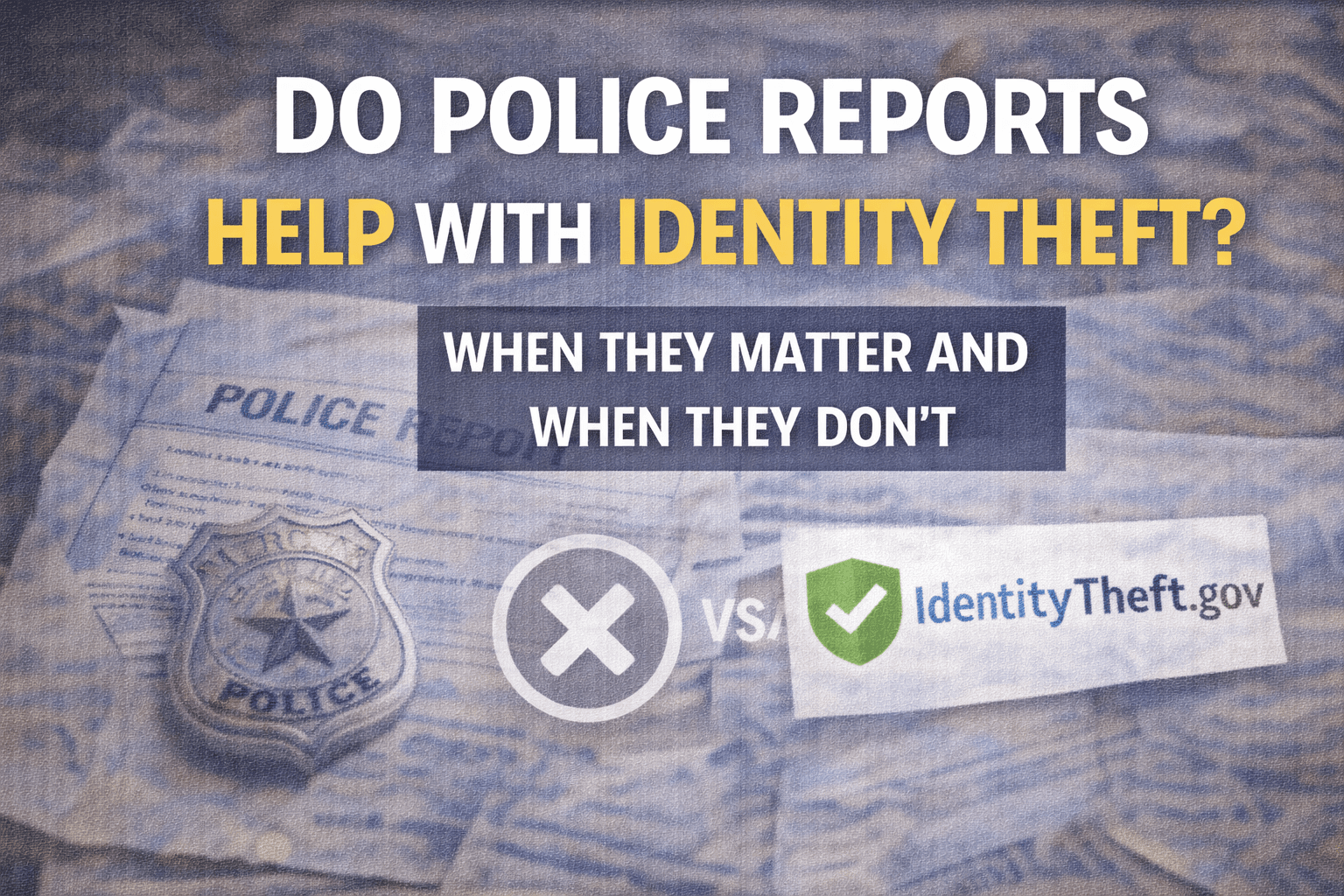
The most important document in identity theft cases is the Identity Theft Report from IdentityTheft.gov.
This report:
Is recognized under federal law
Creates a legal identity theft affidavit
Triggers consumer protection rights
Must be accepted by credit bureaus
Carries more legal weight than a police report alone
In many cases, this affidavit is far more effective than a police report.
Why Banks and Credit Bureaus Ask for Police Reports
Some banks and credit bureaus request police reports to:
Delay resolving claims
Discourage follow-through
Shift responsibility back to the consumer
Create additional hurdles
While police reports can be requested, they cannot be used to deny legitimate disputes outright.
Can a Bank or Credit Bureau Require a Police Report?
Generally:
They may request a police report
They may not automatically deny your claim without one
They must still conduct a reasonable investigation
If a company refuses to act solely because you did not file a police report, that may violate federal law.
When You Should Consider Filing a Police Report
Filing a police report may make sense if:
Identity theft involved large financial losses
Fraud keeps recurring despite disputes
Criminal impersonation is ongoing
You need extra documentation leverage
You plan to pursue legal action
In these situations, a police report can be helpful—but it should be one tool, not your only one.
When Police Reports Don’t Actually Fix the Problem
Police reports often do not fix identity theft when:
Credit bureaus fail to investigate properly
Banks rely on automated denials
Fraudulent accounts continue reporting
Companies ignore federal requirements
At that point, enforcement of consumer rights becomes necessary.
What to Do If Your Identity Theft Claim Is Still Denied
If your identity theft claim is denied—even after filing reports—you should:
Demand written explanations
Preserve all documentation
Dispute inaccuracies in writing
Escalate when investigations are improper
Under federal law, companies can be held accountable for failing to correct identity theft.
Final Answer: Do Police Reports Help With Identity Theft?
Police reports can help in some situations, but they are not required in most identity theft cases and are not the most powerful tool available.
What matters most is timely action, proper documentation, and enforcement of your rights under federal law.
If banks or credit bureaus continue to mishandle your identity theft case, The Credit Attorney helps consumers move beyond paperwork and hold companies accountable when the law is violated.